

Han Bo
The best way to torment oneself is perhaps to work as I do: slowly, stroke by stroke, upon linen, forging mosaics.
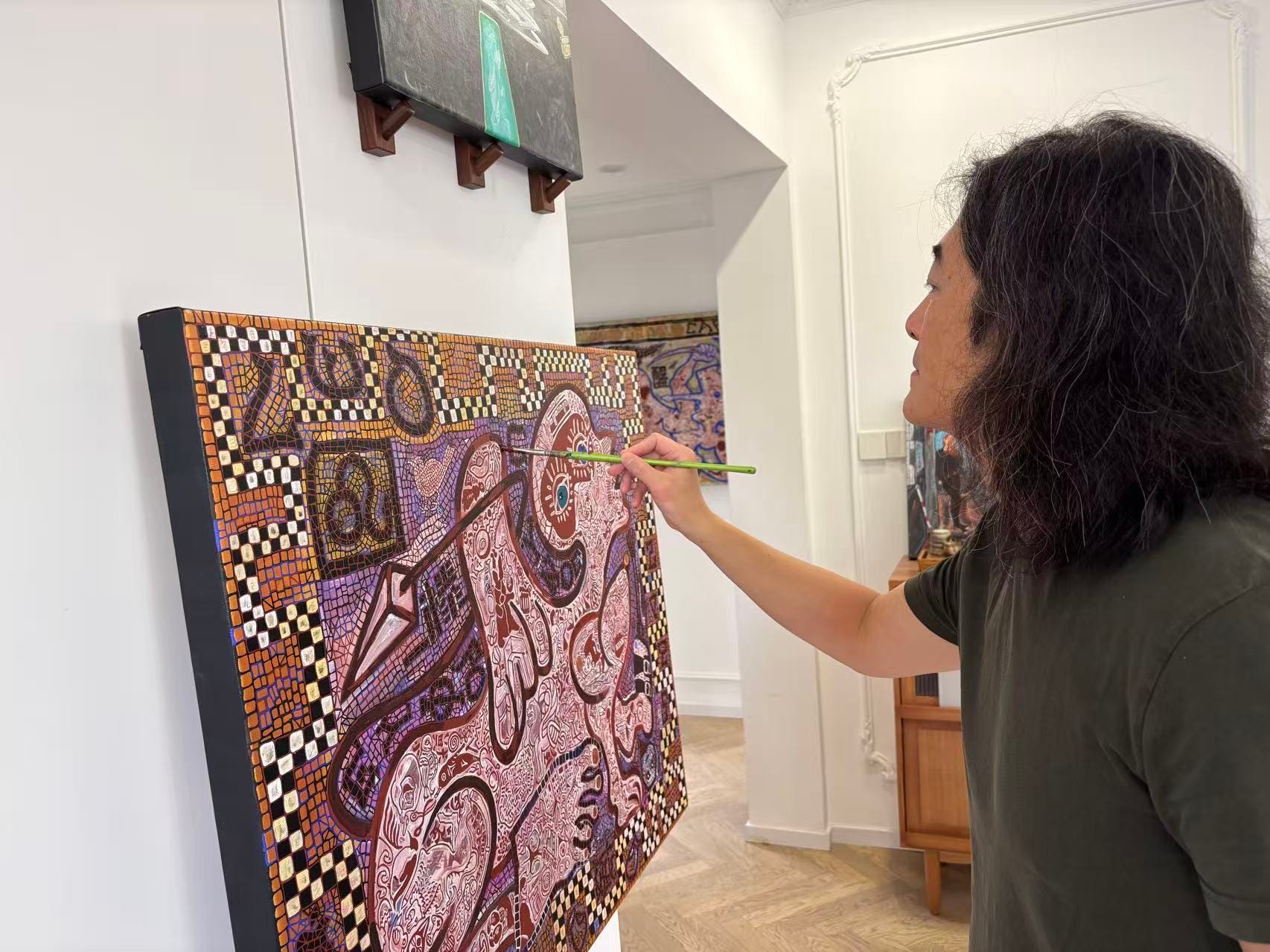
Sigmund Freud would surely have been interested in examining the psychological condition of such a patient. His study—whether in Vienna or later in London—was filled with artifacts from the ancient world, including numerous statues of Venus, Aphrodite, and Astarte, which informed his theories of Eros. Unfortunately, sculptures of Sisyphus pushing his stone were not among them—my case would likely have proved rather difficult.
Almost no clients in antiquity ever commissioned statues of Sisyphus—I have visited many museums and archaeological sites along the Mediterranean coast and have never seen one. Yet Sisyphus—the “proletarian engaged in futile labor and rebellion”—through the gaze of Albert Camus, has become a metaphor for modern humanity. When I was still in middle school, an older poet had already instilled this grotesque name in me.
Sisyphus was the founder of Corinth, a Greek city-state in the northern Peloponnese. He possessed a wild passion for life. In the autumn of 2024, when I finally visited Corinth, I found that the hilltop city overlooking the bay possessed an indescribable wildness of its own. The temperament of Sisyphus seemed to press through the very paper of the city’s planning, even into every block of marble. Homer, in Book VI of The Iliad, calls him “the most cunning of men.” He believed that in war, deception is never too much, and even managed to abduct Thanatos, the god of death—a true precursor to Machiavellianism. Yet the arms of mortals cannot ultimately twist the thighs of the gods. The father of Odysseus—said to be as clever as Zeus (and here twenty thousand words of apocrypha are omitted)—was still sent to the underworld and assigned an extremely “involuted” task. As Camus put it: “The gods condemned Sisyphus to ceaselessly roll a rock to the top of a mountain, whence the stone would fall back of its own weight… they thought there is no more dreadful punishment than futile and hopeless labor,” “a punishment that subjects him to indescribable suffering: he devotes his entire being to an enterprise that has no result.”
Sisyphus is trapped in an instruction system that moves from “internal circulation” to a “closed loop.” This system, operating on the basic principles of physics, endlessly issues commands that completely seize the worker’s energy and drain their time, fixing them permanently in a position of servitude. I, of course, would not dare compare myself to Sisyphus. First, I do not have an illegitimate child like Odysseus—that is a joke. Second, my self-torment does not come from punishment by the gods—though one cannot entirely rule it out. Viewed from an atheistic perspective, however, it is entirely self-inflicted, born simply of idle restlessness.
Seen in this light, my work of forgery possesses none of the tragic dimension of Aeschylus, and is entirely different from the nobility Camus described as “the price one must pay for an infinite love of the earth”—though that idea itself carries a certain French romantic flourish, lacking the cunning and sweat of the Greek hero.
I have nothing that I love. The earth today is no longer a dwelling permeated by “Greekness,” but a space occupied by modernity, contemporaneity, or mere temporariness. The gods have been driven away—including God—and replaced by false gods in human form. These false gods proclaim themselves heroes, yet lack achievements comparable to Achilles or Aeneas. In order to imitate properly, they have learned the methods by which the gods punished Sisyphus: either using utopian futurist aesthetics as a substitute for gravity, or enticing the masses with neoliberal doctrines of success, hoping to elevate the consciousness of the slaves and enable a graceful leap from “being made to be exploited” to “wanting to be exploited.”
And I, too, make such a leap: once the first brushstroke falls, I never know when or where the final one will land. Between the two lies an indefinite expanse of time. There is no shortcut. This is an imitation born of immersion. Having entered the role, I cannot adopt the clever methods of the “conceptualists,” dashing things off with a few bold gestures while throwing in a complimentary mystical interpretation. One who enters the role must be willing to be clumsy, even to revel in clumsiness—wholly devoted to experiencing the limits of Sisyphus-like exertion in order to approach the reality of “self-exploitation.”
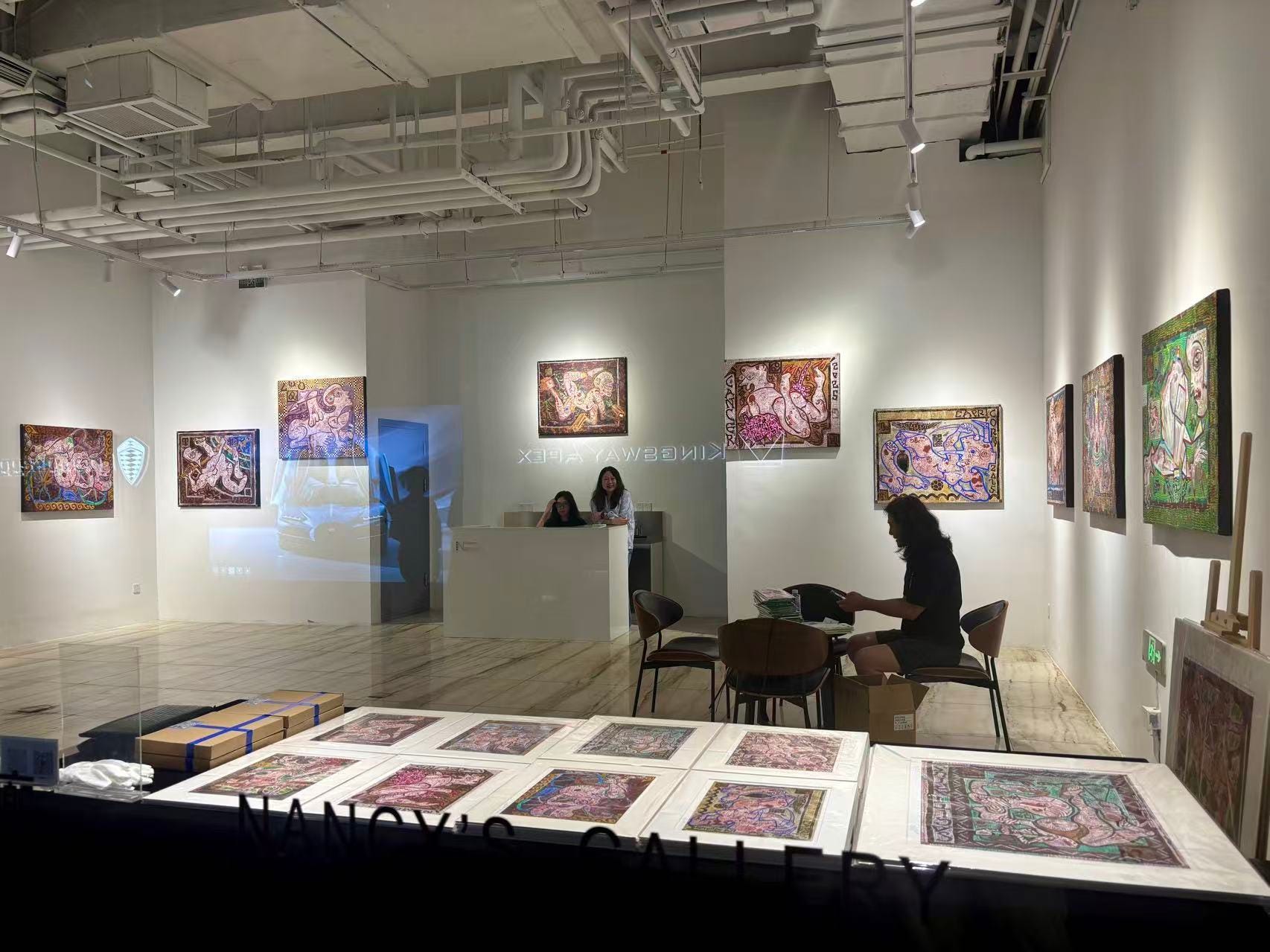
Yet, to speak frankly, the place where I practice my forgeries is worlds apart from the environment inhabited by the popular philosopher Byung-Chul Han, who promotes such concepts. From this perspective, like southern oranges turning into northern trifoliates, my labor more closely resembles the small peasant economy observed a century ago by the Soviet agrarian economist Alexander Chayanov: caught between the promises of Gaia and the tricks of the Fates, while also burdened by arbitrary tyranny and the heavy yoke of the family system.
Of course, at certain moments, one immersed in the role may grow arrogant. The limitations of consciousness lead to misjudgments of reality: one imagines oneself, possessed by Sisyphus, to also be Diogenes of Sinope; one mistakes the stone that requires exhausting effort merely to manage for a barrel rolling leisurely along like a walk in the garden. But how could one not, when the situation appears so splendid—so splendid it burns? The bustling world rushes toward the age of the “yin-yang hotpot”; the lively crowd gathers to make a joke of itself. Everyone else is busy—you, too, must find something to do, lest you idle into becoming a “social parasite.”
What a metaphor! Diogenes would never stoop to hauling stones like a laborer. He rolled his barrel for the sake of performance—to demonstrate that he had never “lain flat”—turning the useless into something thoroughly useful. Where would I obtain such wisdom? Besides, as Master Lu Buxun once said: a barrel initially has no patina, but after enough rolling, it acquires one; and once it has patina, the barrel becomes like a string of prayer beads—transforming into an Eastern wisdom in resistance to Western material civilization. At such a lofty level of performance, how could a forger possibly keep up? Just thinking of those “people’s artists” who count their beads while raising their backsides high, burying their heads in the sand in praise of a tranquil age—I feel like dying.